Which amber?
Deposits, names, and a younger cousin
“It is important to say that amber is much studied but still not fully understood.” The problems, the Getty essay says, “begin with the names.” This desk starts there, then sets official deposits side by side.[source]
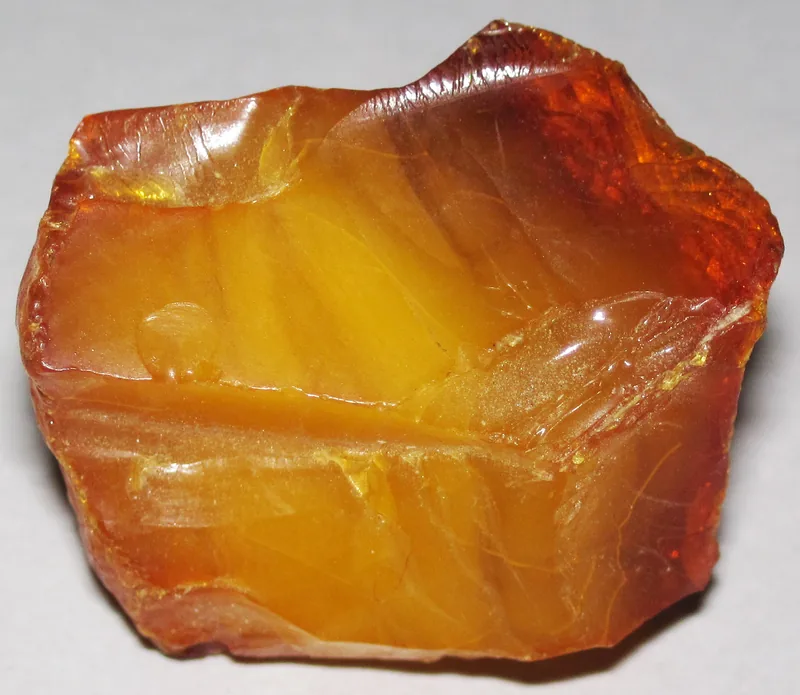
“Geologically, amber has been documented throughout the world, with most deposits found in Tertiary-period sediments dating to the Eocene, a few to the Oligocene and Miocene, and fewer still to later in the Tertiary.” Most known accumulations “are redepositions.” Amber “did not originate in the place where it was found.” After the trees fell, “the resin-coated logs were carried by rivers and tides to deltas in coastal regions, where they were buried over time in sedimentary deposits.”[source]
In the “amber forest,” the Getty essay says, “resin oozed down trunks and branches and formed into blobs, sheets, and stalactites, sometimes dripping onto the forest floor. On some trees, exuded resin flowed over previous flows, creating layers.” That sticky flow “collected detritus and soil and sometimes entrapped flying and crawling creatures.”[source]
The same official essay illustrates that old idea with a hand-coloured woodcut, “Amber formed on trees,” from Ortus sanitatis, printed at Mainz by Jacob Meydenbach on 23 June 1491, now courtesy of the Boston Medical Library in the Francis A. Countway Library of Medicine. It is an official historical picture of a question people have been asking for a very long time.[source]
Baltic amber is the famous European deposit, also called succinite. The labelled Yantarnyi beetle and flies on this site carry a Middle Eocene, Lutetian, “Blue Earth layer” Amber Formation label. Those dates stay with those specimens. They are not used here as a date for every Baltic piece.[source]
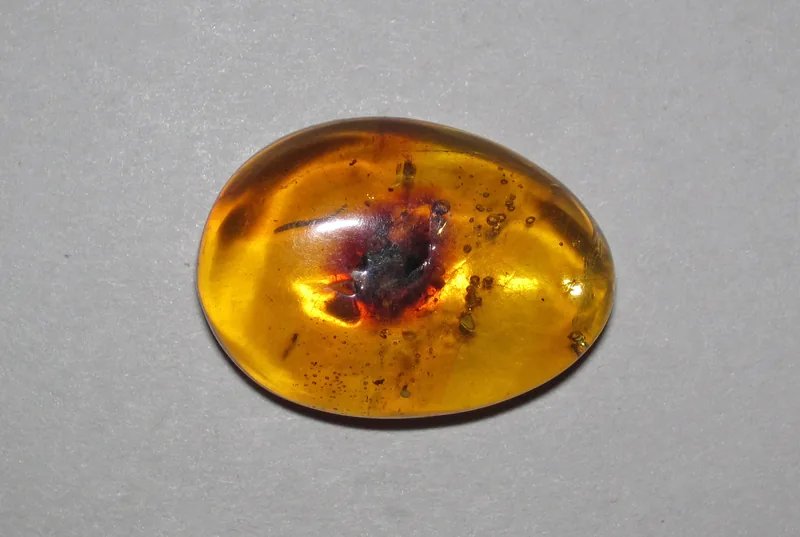
The American Museum of Natural History houses “a very diverse collection of amber fossils from the Miocene of the Dominican Republic,” with smaller collections “from the Paleocene of Wyoming, Eocene of Arkansas, Miocene of Mexico, and other localities.” It also holds “pre-eminent collections of Cretaceous amber” from five published places and ages.[source]
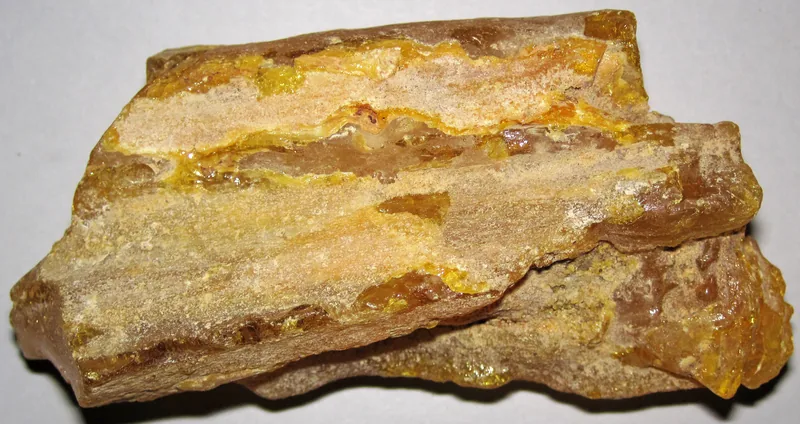
And then there is copal. AMNH holds “a large amount of copal (subfossil resin) from Zanzibar that contains myriad insect inclusions.” The Getty essay, quoting David Grimaldi, treats amberization as a continuum: “No single feature identifies at what age along that continuum the substance becomes amber.” Some experts want several million years; others, as recent as 40,000 years. The copal photograph on this site has no provenance in its file, and is captioned that way.[source][source]
Enjoyed this amber desk?
No pop-ups. No intrusive advertising. Just interesting stuff. A little support helps the next fossils.im site get built.