“The sticky substance collected detritus and soil and sometimes entrapped flying and crawling creatures.” Official pages then marvel at how well those creatures can still be seen.[source]
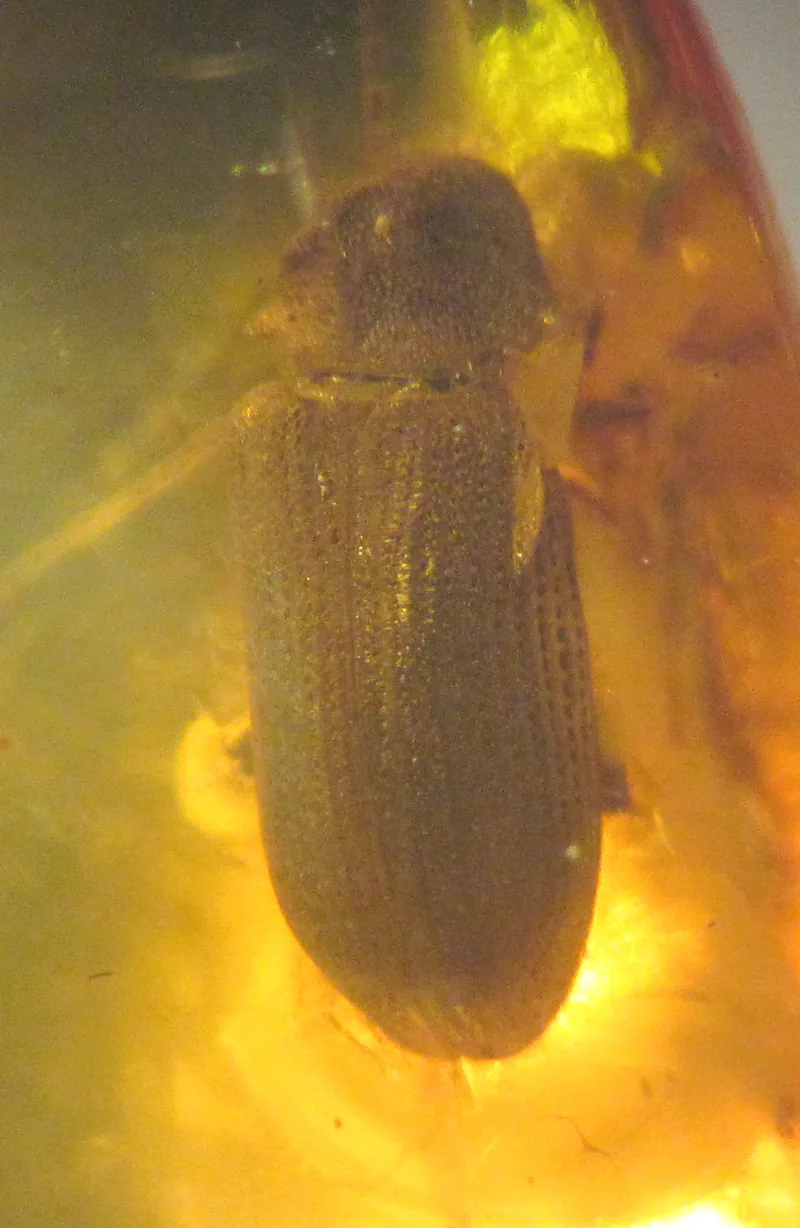
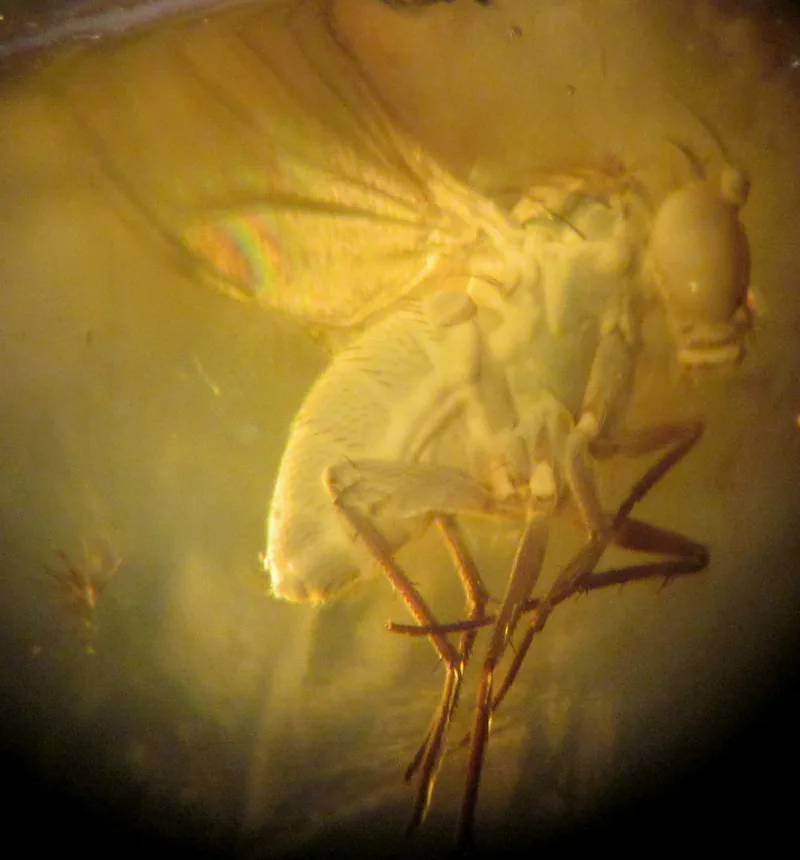
A fossil beetle, about 3.5 millimetres long, in Baltic amber from Yantarnyi on the Samland Peninsula, western Russia. The specimen label gives the Amber Formation, the “Blue Earth layer”, and the Lutetian Stage of the lower Middle Eocene. Those dates stay with this labelled specimen. James St. John, CC BY 2.0. The original is 988 pixels wide, so this site uses 400- and 800-pixel stills only.Photo: James St. John · CC BY 2.0 · Wikimedia CommonsA fossil fly in Baltic amber from Yantarnyi, western Russia. The field of view is about 4 millimetres from top to bottom. The same Eocene label as the beetle applies to this specimen. James St. John, CC BY 2.0.Photo: James St. John · CC BY 2.0 · Wikimedia Commons
“Amber can also preserve plant matter, bacteria, fungi, worms, snails, insects, spiders, and (more rarely) small vertebrates. Some pieces of amber contain water droplets and bubbles, products of the chemical breakdown of organic matter.” How resins preserve organic matter “is not entirely understood,” but “presumably the chemical features of amber that preserve it over millennia also preserve flora and fauna inside it.”[source]
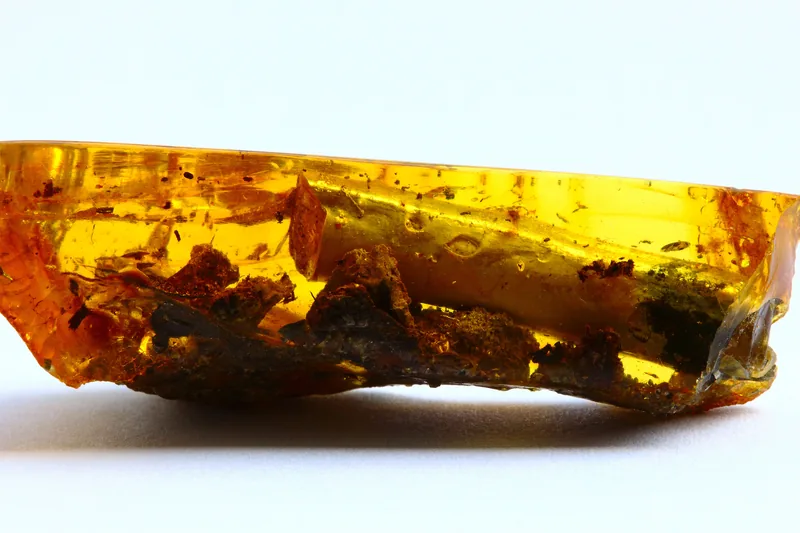
Baltic amber with plant inclusions, 5.5 centimetres across, photographed by PrinWest Handelsagentur J. Koch. Licensed CC BY 3.0. Official pages note that amber can preserve plant matter as well as insects and, more rarely, small vertebrates.Photo: PrinWest Handelsagentur J. Koch · CC BY 3.0 · Wikimedia Commons
The Getty essay quotes a line about “amazing life-like fidelity of preservation,” which “occurs through rapid and thorough fixation and inert dehydration as well as other natural embalming properties of the resin that are still not understood.” That fidelity is a scientific remark about form. It is not a claim, on this site or on the official pages used here, that dinosaur DNA has been recovered from amber.[source]
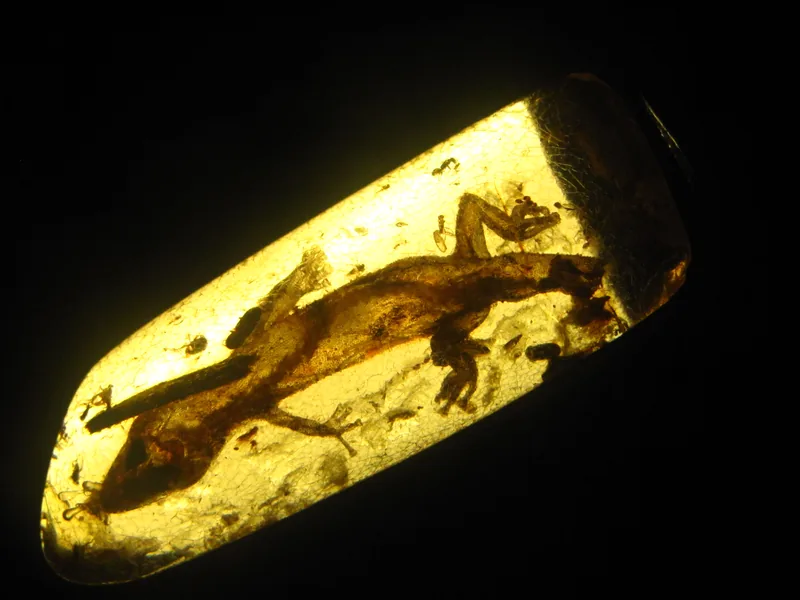
A gecko in amber, photographed by PG Palmer on 2 July 2011 at the Australian Fossil and Mineral Museum in Bathurst, New South Wales, as part of the Somerville Collection. The file describes it as an Oligocene-era gecko. Licensed CC BY-SA 2.0; used on this website only, not in the fact sheets. Official pages say amber more rarely preserves small vertebrates. This site does not invent a source deposit beyond the file and museum caption.Photo: PG Palmer, 2 July 2011 · CC BY-SA 2.0 · Wikimedia Commons
Small vertebrates are the rare official case. A gecko in amber, photographed in 2011 at the Australian Fossil and Mineral Museum in Bathurst as part of the Somerville Collection, is on this page. The file describes it as an Oligocene-era gecko. That wording stays with the file and the museum caption.[source]
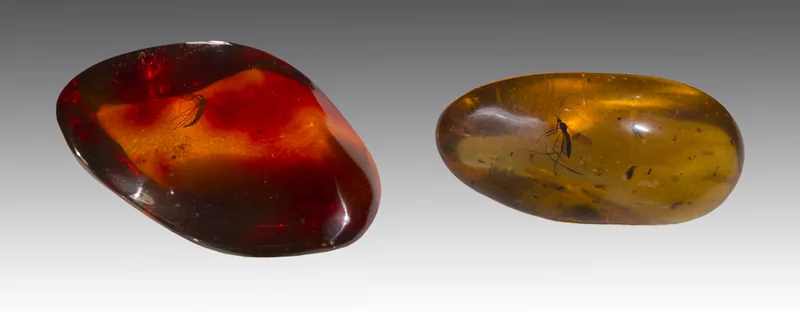
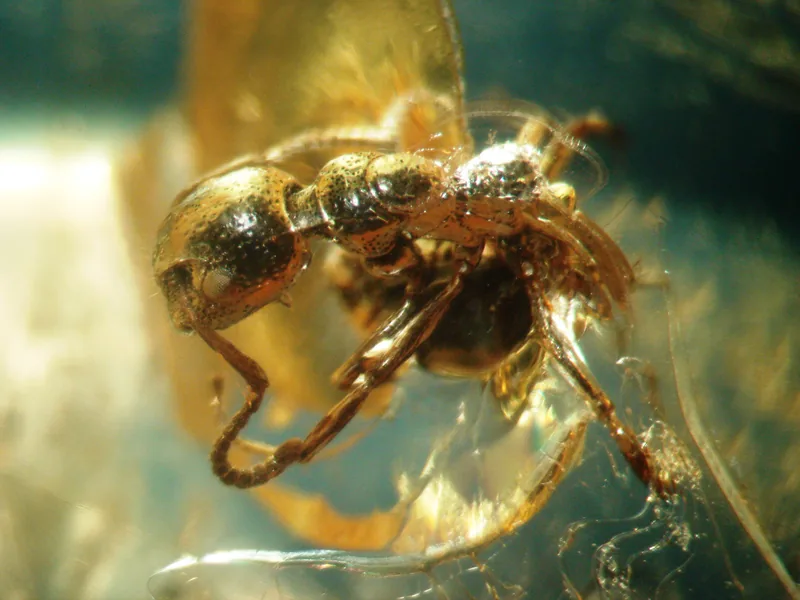
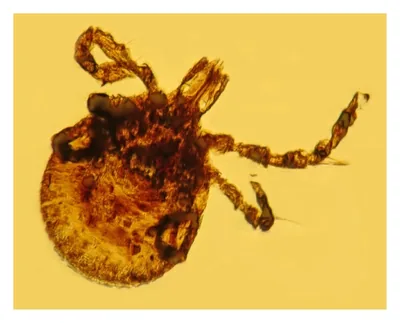
A mosquito in amber from the Northern Cordillera, Dominican Republic, photographed by Didier Descouens. Licensed CC BY-SA 4.0; used on this website only, and not placed in the typographic fact sheets. The file names the locality; this site does not add a date the file does not give.Photo: Didier Descouens (Archaeodontosaurus) · CC BY-SA 4.0 · Wikimedia CommonsA fossil ant (Formicidae), about 4 millimetres long, in Baltic amber, photographed by Anders L. Damgaard. Licensed CC BY-SA 4.0; used on this website only, not in the fact sheets. The file caption gives an age of 40–50 million years; that wording stays with the file, and is not blended with the Middle Eocene labels on the Yantarnyi specimens.Photo: Anders L. Damgaard · CC BY-SA 4.0 · Wikimedia CommonsA larval hard tick (Amblyomma) in Dominican amber, photographed by George Poinar Jr. Licensed CC BY 3.0. The original is only 600 × 485 pixels, so this site uses a 400-pixel still only, and does not upscale it.Photo: George Poinar Jr. · CC BY 3.0 · Wikimedia Commons
AMNH puts the same marvel in curator’s language: because amber “preserves with microscopic fidelity, it allows uniquely accurate estimates of the amount of evolutionary change over millions of years.” Arthropods are “the most diverse life forms in amber, though plants and rare soft-bodied invertebrates can also be preserved.”[source]
“It is not entirely understood how resins preserve organic matter, but presumably the chemical features of amber that preserve it over millennia also preserve flora and fauna inside it.” Some pieces, the Getty essay says, “contain water droplets and bubbles, products of the chemical breakdown of organic matter.” The bubbles in a piece of amber are not automatically a trapped gulp of ancient air in the way a film might wish.[source]
Keep the lights on
Enjoyed this amber desk?
No pop-ups. No intrusive advertising. Just interesting stuff. A little support helps the next fossils.im site get built.