Copal, and a continuum
When does resin become amber?
“How long does it take for buried resin to become amber?” The Getty essay’s answer is that there is no single answer.[source]
“The amberization process is a continuum extending from freshly hardened resins to rocklike ones, and, as David Grimaldi points out, ‘No single feature identifies at what age along that continuum the substance becomes amber.’” Langenheim, quoted on the same page, adds that maturity increases with age, “but the rate at which it occurs depends on the prevailing geologic conditions as well as the composition of the resin.” Changes “appear to be a response primarily to geothermal stress since chemical change in the resin accelerates at higher temperatures.”[source]
“While some experts maintain that only material that is several million years old or older is sufficiently cross-linked and polymerized to be classified as amber, others opt for a date as recent as forty thousand years before the present. Much depends on the soil conditions of the resin’s burial.”[source]
Chemically, the resin “originally contained liquids (volatiles) such as oils, acids, and alcohols, including aromatic compounds (terpenes) that produce amber’s distinctive resinous smell. Over time, the liquids dissipated and evaporated from the resin, which began to harden as the organic molecules joined to form much larger ones called polymers.” Under the right conditions, “the hardened resin continued to polymerize and lose volatiles, eventually forming amber, an inert solid that, when completely polymerized, has no volatiles.” “Most important, the resins that became amber were buried in virtually oxygen-free sediments.”[source]
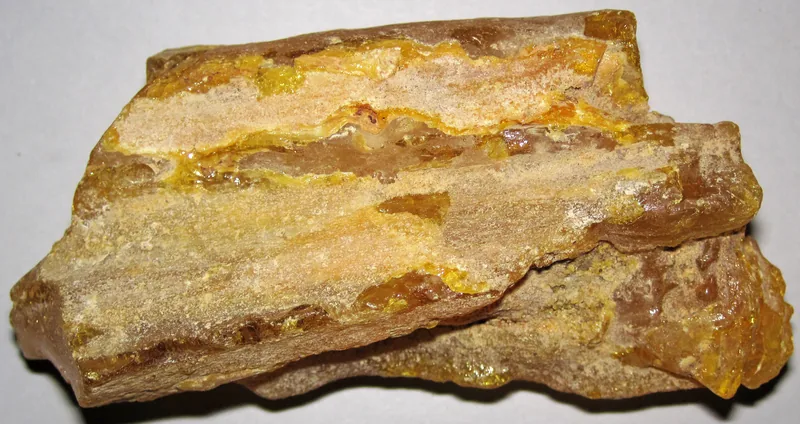
The American Museum of Natural History holds “a large amount of copal (subfossil resin) from Zanzibar that contains myriad insect inclusions.” That official collection has a locality. The copal photograph on this site does not. The file gives no provenance. Crazing is visible, which notes citing Grimaldi often mention for copal. This page does not invent a locality for the picture.[source][source]
“In its final form, amber is much more stable than the original substance.” The Getty essay adds a comparison that is easy to misread, and then unpicks it: amber “is organic, like petrified wood or dinosaur bones, but, unlike those substances, it retains its chemical composition over time, and that is why some experts resist calling it a fossil resin (a nevertheless useful term).” This desk uses the useful term, and keeps the official caution beside it.[source]
A Getty footnote, quoting Andrew Ross’s Amber: The Natural Time Capsule, adds a general official composition: “The polymers are cyclic hydrocarbons called terpenes.… Amber generally consists of around 79% carbon, 10% hydrogen, and 11% oxygen, with a trace of sulphur.” Ross, the same essay notes, also points to “the critical element of the kinds of sediments in which the resin was deposited,” and to a question that is “not so clear”: “the effect of water and sediment chemistry on the resin.”[source]
“The highly complex process that results in amber formation gave rise to a wealth of speculation about its nature and origins.” Official pages still prefer the continuum, the un-named Baltic tree, and the unanswered chemistry, to a single tidy story.[source]
Enjoyed this amber desk?
No pop-ups. No intrusive advertising. Just interesting stuff. A little support helps the next fossils.im site get built.