Discoveries
Sixteen official stories
Each story here is taken from official wording, or from a labelled specimen caption that this site keeps with its photograph.
A name that confuses
The Getty essay lists amber, Baltic amber, fossil resin, succinite and resinite, and says “they have confused as much as they have clarified.”[source]
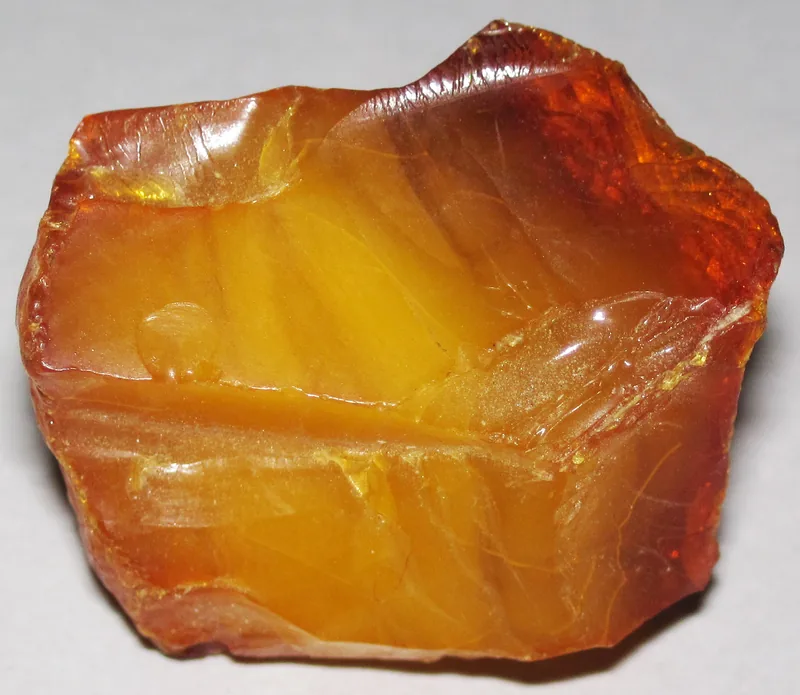
A tree we still cannot name
There is “no definite conclusion about the botanical source of the vast deposits of Baltic amber.” It is “not derived from the modern species of Pinus.” An extinct ancestral tree is “probably the only solution.”[source]
A tree’s own sticking plaster
Resin “protects trees by blocking gaps in the bark.” Its stickiness “can gum up the jaws of gnawing and burrowing insects,” and can trap flying and crawling creatures.[source]
Seldom found where it grew
“Most amber did not originate in the place where it was found.” “Most known accumulations of amber are redepositions.”[source]
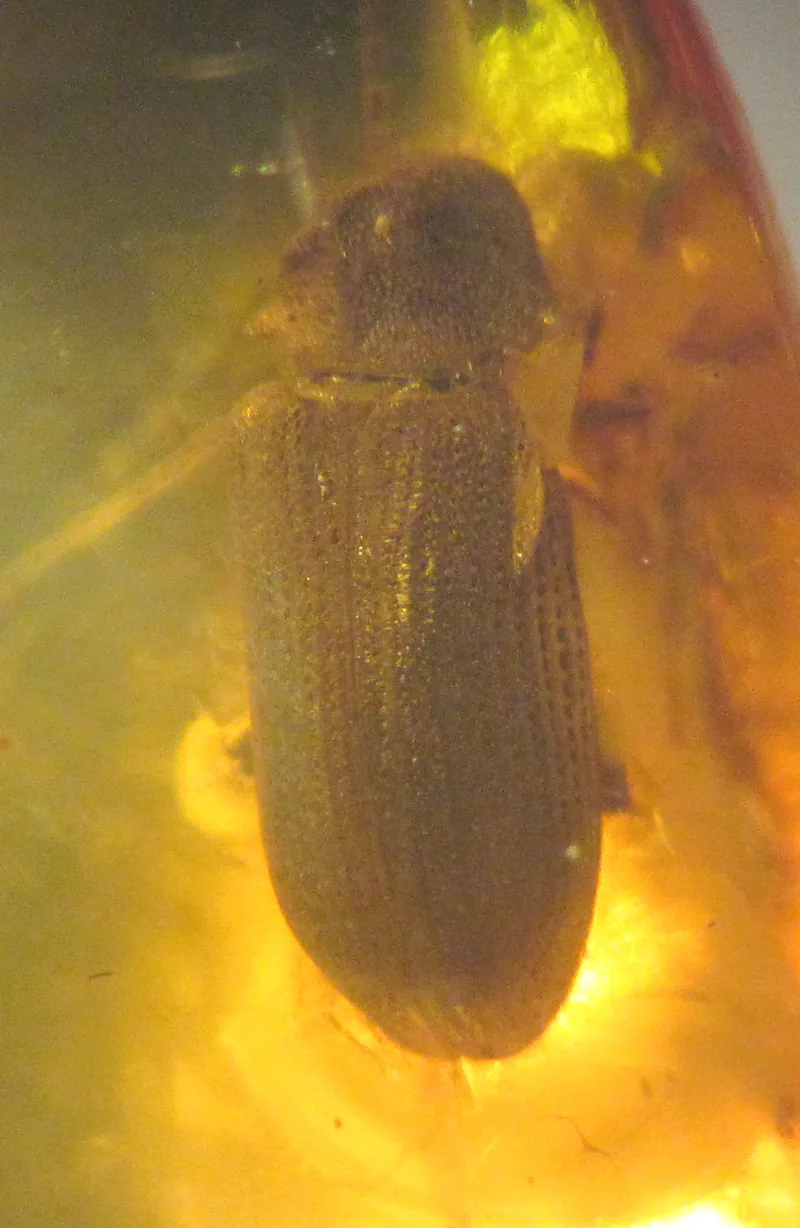
A labelled beetle, 3.5 millimetres long
The Yantarnyi beetle carries a Middle Eocene, Lutetian, “Blue Earth layer” Amber Formation label. Those dates stay with this specimen.[source]
A Miocene collection
AMNH “houses a very diverse collection of amber fossils from the Miocene of the Dominican Republic.”[source]
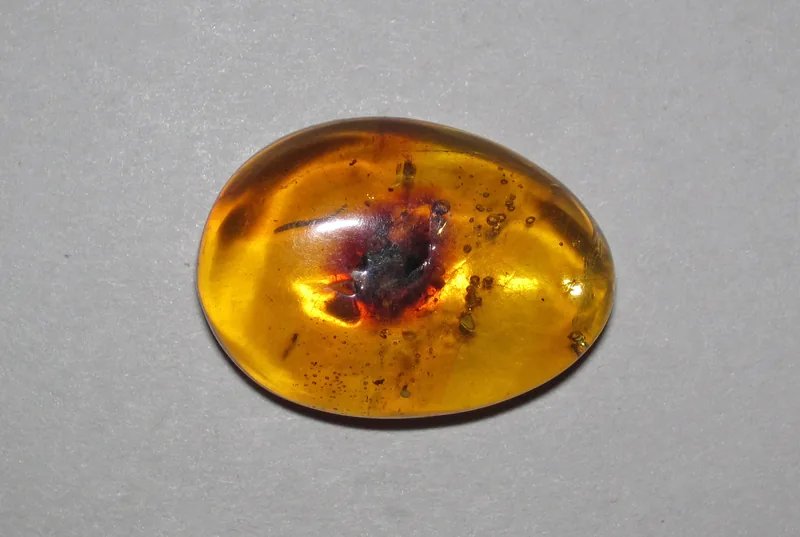
Five Cretaceous holdings
AMNH holds about 10,000 pieces of Cretaceous amber from Lebanon (c. 125 Ma), Myanmar (c. 100 Ma), Alaska (95 Ma), New Jersey (c. 90 Ma), and Alabama (ca. 85 Ma).[source]
When is it amber?
Amberization is a continuum. “No single feature identifies at what age along that continuum the substance becomes amber.” Some experts want several million years; others, as recent as 40,000 years.[source]
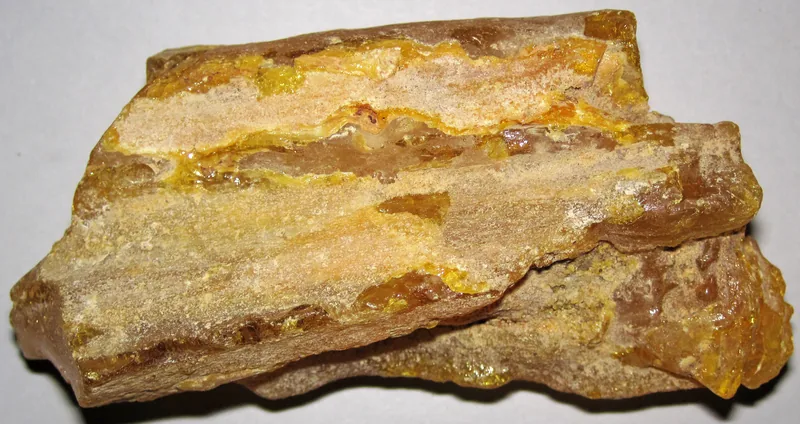
Zanzibar copal
AMNH holds “a large amount of copal (subfossil resin) from Zanzibar that contains myriad insect inclusions.” The copal photograph on this site has no provenance, and is captioned as such.[source]
Lifelike, but not a film story
Official pages speak of “amazing life-like fidelity of preservation” through rapid fixation and inert dehydration. They do not say that dinosaur DNA has been recovered.[source]
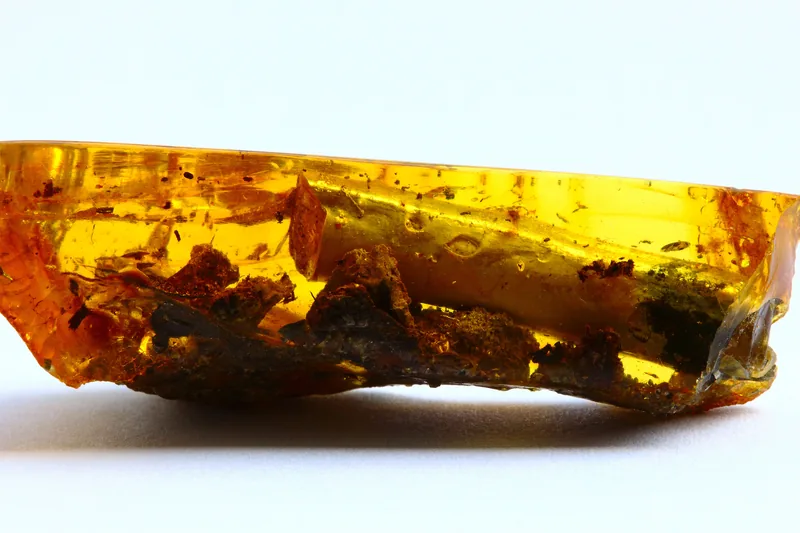
Plant matter in the resin
“Amber can also preserve plant matter,” as well as insects and, more rarely, small vertebrates. A 5.5-centimetre Baltic piece on this site shows plant inclusions.[source]
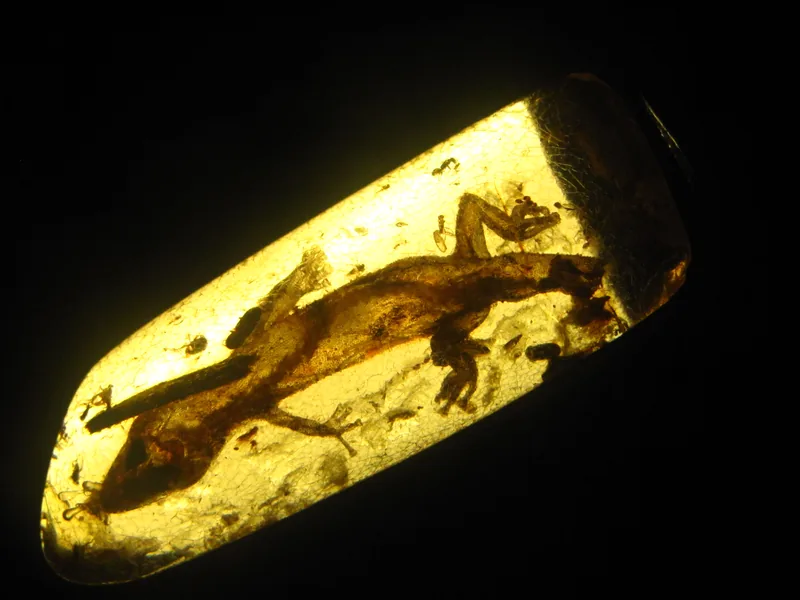
More rarely, a small vertebrate
A gecko in amber, photographed in the Somerville Collection in Bathurst, appears here with the file’s wording: an Oligocene-era gecko.[source]
Microscopic fidelity
Because amber “preserves with microscopic fidelity, it allows uniquely accurate estimates of the amount of evolutionary change over millions of years.”[source]
Almost 400 holotypes
As of 2009 there were “almost 400 holotypes in the amber collection” at AMNH. The collection grew enormously after David Grimaldi joined the staff in 1986.[source]
The world’s largest collection of fossil bees
AMNH houses “the world’s largest collection of fossil bees,” which “are very rare in Baltic amber,” methodically assembled by M. S. Engel.[source]
A smell of terpenes
The original resin contained “aromatic compounds (terpenes) that produce amber’s distinctive resinous smell.” Over time those liquids dissipated, and the molecules joined into polymers.[source]
Enjoyed this amber desk?
No pop-ups. No intrusive advertising. Just interesting stuff. A little support helps the next fossils.im site get built.